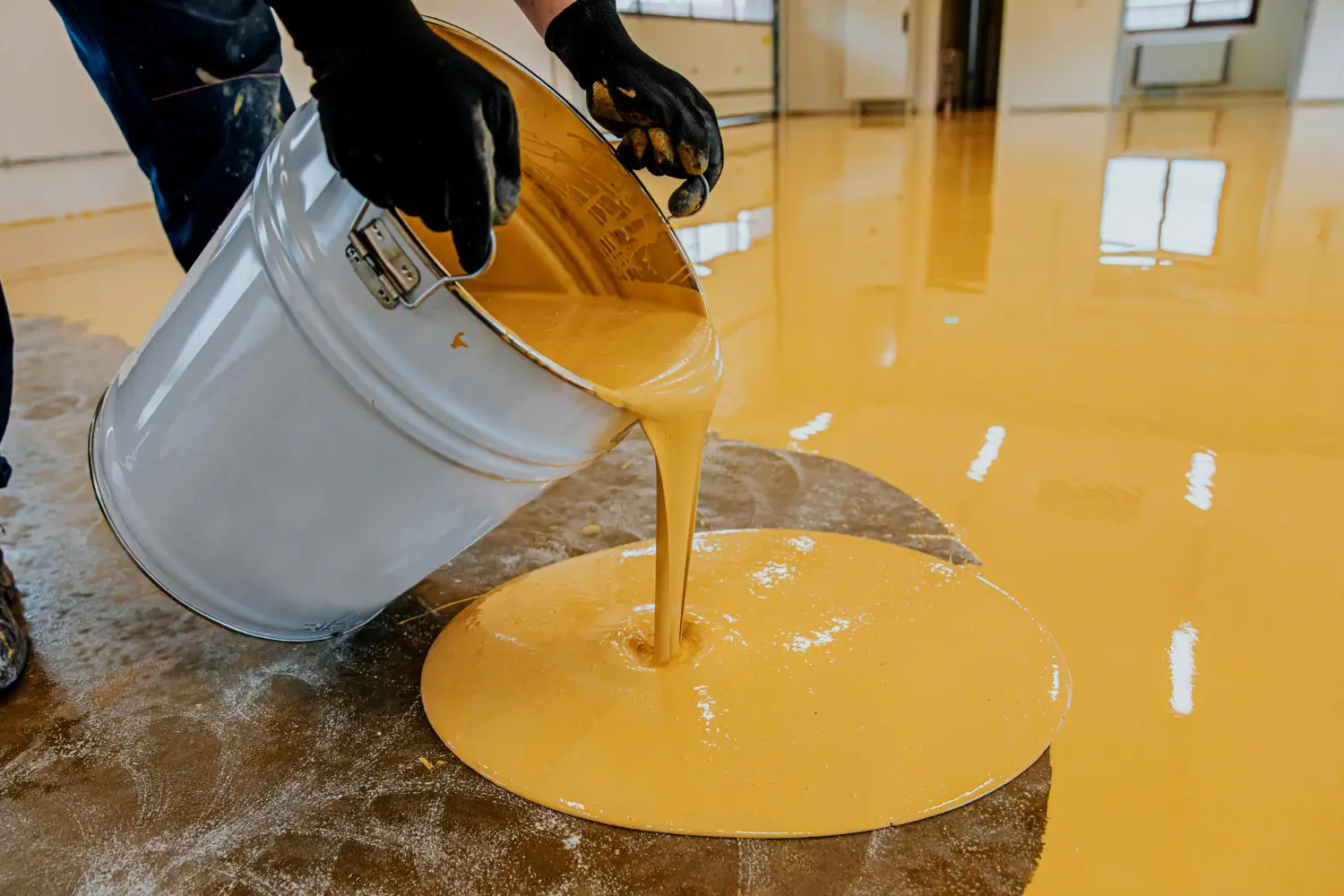
Epoxy floor coating — the world's first choice for industrial floors — is a two-component, resin-based protection system applied over concrete. From factories to car parks, food facilities to showrooms, it eliminates dusting on heavily used floors, maximises chemical and mechanical resistance, and delivers a hygienic, seamless and easy-to-clean surface. With over 10 years of field experience, IZZOBOSS selects the epoxy system best suited to your project's purpose and load conditions, and applies it with correct surface preparation, quality materials and a guarantee.
What Is Epoxy Floor Coating?
Epoxy is a coating that cures chemically when epoxy resin and hardener are mixed in a set ratio, bonding strongly to concrete. Once cured, the surface offers high resistance to impact, abrasion, oils, acids and many chemicals. Unlike ordinary paint, it does not leave a thin film; instead it forms a monolithic, seamless floor of millimetre-scale thickness as required.
Epoxy Floor Coating Systems and Types
No two floors are the same; the right system is chosen according to the load, chemical exposure and intended use. The most common epoxy systems are:
| System | Typical Thickness | Key Feature | Suitable For |
|---|---|---|---|
| Self-levelling | 1-3 mm | Smooth, glossy, decorative surface | Showrooms, warehouses, light-medium industry |
| Multi-layer / broadcast | 2-4 mm | High abrasion resistance and anti-slip | Production facilities, ramps, wet areas |
| Epoxy mortar | 4-9 mm | Resistance to heavy impact and load | Heavy industry, forklift traffic |
| Anti-static / ESD | 1-3 mm | Safely dissipates static electricity | Electronics, pharma, sensitive production |
We confirm which system suits your floor during the site survey, after understanding your load, chemical exposure and aesthetic expectations.
Where Is Epoxy Flooring Used?
- Factories and production facilities: floors that withstand heavy loads and forklift traffic
- Warehouses and logistics centres: dust-free, flat floors with line markings
- Open and covered car parks: anti-slip, durable and low-maintenance systems
- Food and pharmaceutical facilities: antibacterial, hygienic and easy-to-disinfect surfaces
- Hospitals and laboratories: anti-static, seamless applications
- Showrooms, stores and commercial areas: aesthetic, glossy and decorative finishes
- Workshops and technical services: oil- and chemical-resistant floors
Advantages of Epoxy Floor Coating
- High mechanical and chemical resistance
- Completely eliminates dusting
- Seamless, non-porous and hygienic surface
- Easy to clean with low maintenance cost
- Customisable with anti-slip, anti-static and colour options
- Long-lasting; delivers years of performance when applied correctly
- Colour and line zoning can be applied for workplace safety
The Epoxy Application Process
The secret to a durable result lies as much in surface preparation as in the coating itself. The IZZOBOSS process consists of these steps:
- Floor analysis and moisture measurement: the concrete's strength and moisture content are checked; epoxy bonds properly only at a suitable moisture level.
- Surface preparation: the concrete is mechanically roughened by diamond grinding or shot blasting; dust, oil and loose particles are removed.
- Repair: cracks, voids and defects are repaired with epoxy-based repair mortars.
- Primer: a moisture-tolerant primer ensures a flawless bond to the concrete.
- Main coat: a self-levelling, broadcast or mortar epoxy is applied per the chosen system.
- Top coat and details: anti-slip aggregate, line markings and a protective top coat are completed where required.
Epoxy Floor Coating Prices (2026)
The price per square metre is not fixed; it is determined by several factors:
- Size of the area: the cost per square metre usually decreases as the area grows.
- System type and coating thickness: self-levelling, broadcast and mortar systems differ in cost.
- Condition of the existing concrete: the need for grinding, repair and a moisture barrier affects the price.
- Special requirements such as colour, anti-slip or anti-static properties.
For this reason, the most accurate price is produced with an on-site survey. Contact us for a free site survey and quote.
Maintenance and Cleaning of Epoxy Floors
Because epoxy floors are non-porous and seamless, they are very easy to maintain. A damp mop or a floor-cleaning machine is enough for daily cleaning; non-abrasive, neutral cleaners are recommended. Regular maintenance preserves the floor's gloss and lifespan for many years.
Common Mistakes in Epoxy Application
- Inadequate surface preparation (applying without grinding)
- Not measuring concrete moisture; applying to a damp floor causes blistering
- Choosing the wrong system (e.g. self-levelling for heavy loads)
- Skipping or under-applying the primer
- Applying at too low a temperature or in high humidity
IZZOBOSS applies with correct measurement and the right materials, leaving no room for any of these mistakes.
Why IZZOBOSS?
With over 10 years of experience, an expert field team and quality material supply, we deliver epoxy floor solutions that maintain day-one performance for years in factory, warehouse and car-park projects. We provide a workmanship guarantee on the floors we apply and complete the job with a pre-delivery quality check. You may also review our complementary services: polyurethane waterproofing and spray polyurethane foam insulation.
Frequently Asked Questions
How much does epoxy floor coating cost per square metre?
The price depends on the size of the area, system type, coating thickness and the condition of the existing concrete. We recommend a free site survey for an accurate per-square-metre price.
How soon is an epoxy floor ready for use?
Depending on the system and ambient temperature, the surface is usually open to foot traffic after 24 hours and to full load after 3-7 days.
Can epoxy be applied over an old concrete floor?
Yes. If the concrete is sound, epoxy can be applied over the existing floor after proper surface preparation.
What thickness is epoxy flooring applied at?
It varies by use: decorative self-levelling systems are 1-3 mm, while epoxy mortar systems for heavy industry can be 4-9 mm thick.
Should I choose an epoxy or a polyurethane floor?
Epoxy offers high hardness and chemical resistance; a polyurethane floor is more flexible and more resistant to UV and temperature changes. The right choice is determined by use during the survey.
Is an epoxy floor slippery?
Standard epoxy is glossy and smooth; for wet or sloped areas, anti-slip aggregate is added to create a safe texture.
Can epoxy floors be used in open car parks?
In exposed areas, standard epoxy may yellow over time under UV; for outdoor use, systems with a UV-resistant top coat are recommended.
How long does an epoxy floor last?
A correctly applied and maintained epoxy floor performs for many years; its lifespan depends on the system type, traffic intensity and maintenance.
Want a durable, dust-free floor for your factory, warehouse or car park? Request a free site survey now and let us recommend the best epoxy system for you.