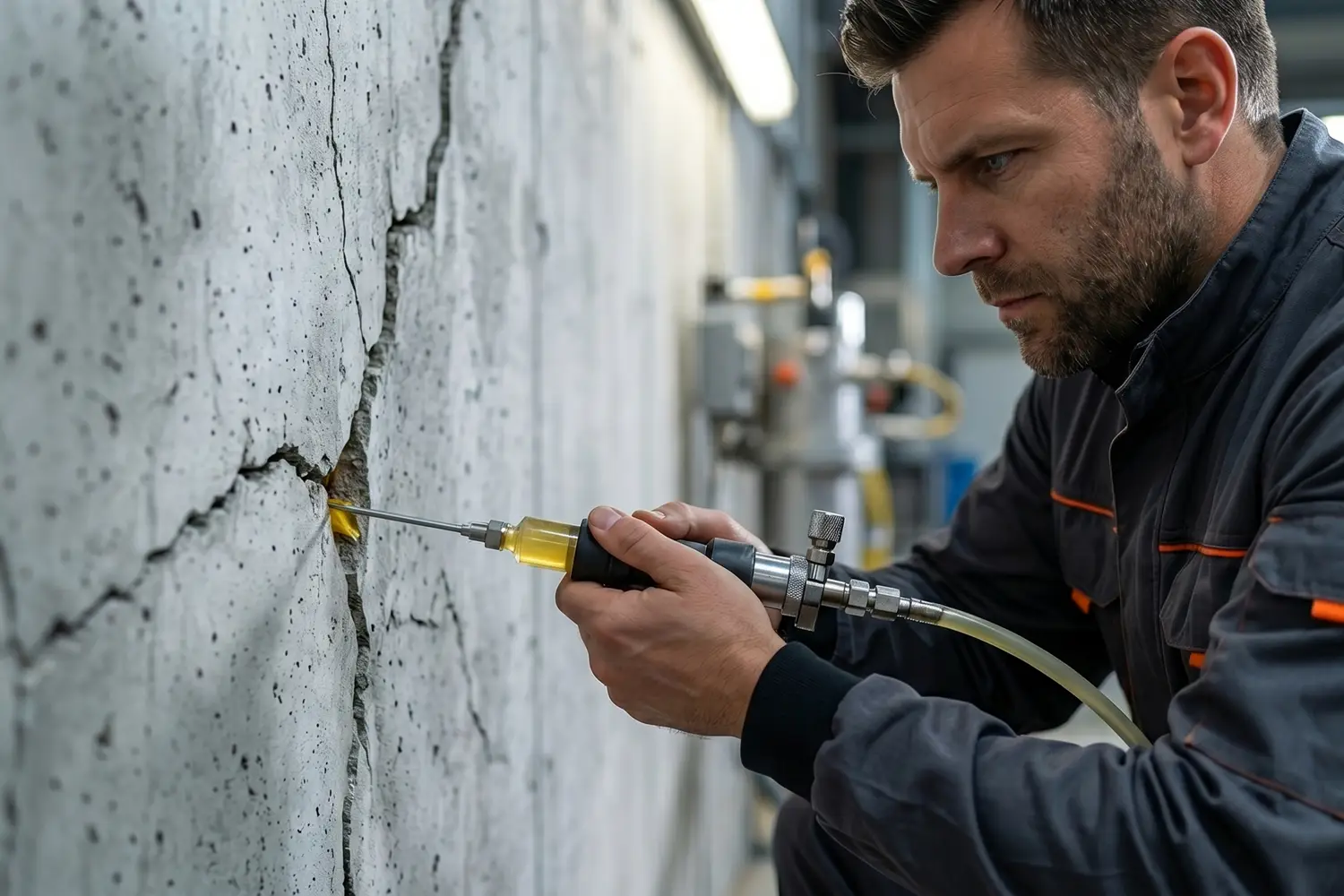
Concrete crack injection is a negative-side waterproofing method in which resin is injected under pressure to stop water leaking through cracks in reinforced concrete and to fill the crack. It is one of the most effective solutions for elevator pits, basement retaining walls, retaining structures and water tanks with active water flow. Using polyurethane and epoxy injection resins, IZZOBOSS instantly stops water coming through a crack.
What Is Concrete Crack Injection?
Through packer (injection nipple) holes drilled at intervals along the crack, resin is delivered into the crack under high pressure with special pumps. The resin fills voids completely and cuts off the water path. Because the method can be applied from indoors without excavation, it offers a major advantage especially in basements and elevator pits.
Polyurethane or Epoxy Injection?
The resin is chosen according to the condition of the crack:
| Resin | How It Works | Suitable Case |
|---|---|---|
| Polyurethane (PU) injection | Expands on contact with water, filling the void as foam | Cracks with active water flow |
| Epoxy injection | Bonds with high strength (monolithic bond) | Dry/dormant, structural cracks |
Where Is It Used?
- Elevator pits: stopping water ingress from the base and walls
- Basements and retaining walls: active water cut-off from the negative side
- Retaining and foundation walls: cold-joint and crack leaks
- Water tanks and pools: eliminating leaks through structural cracks
- Tunnels and car-park walls: waterproofing under pressurised water
Advantages of the Injection Method
- Can stop active water flow from the inside (negative side)
- Can be applied from indoors without excavation
- Polyurethane resin expands with water to fill voids completely
- Epoxy resin restores structural integrity
- Fast results; in most applications water is cut off immediately
Application Process
- Assessment: the crack type, direction and intensity of water flow are determined.
- Packer placement: angled holes are drilled along the crack and injection nipples are fixed.
- Injection: the appropriate resin (polyurethane/epoxy) is delivered into the crack with a pressure pump.
- Check and clean-up: water cut-off is verified, packers are removed and the surface is finished.
Concrete Crack Injection Prices (2026)
The price depends on the length and depth of the crack, the water pressure and flow rate, the resin type used and access difficulty. An on-site survey is required for an accurate quote. Contact us for a free site survey.
Common Mistakes
- Using epoxy (non-expanding) resin on active water flow
- Setting the packer spacing incorrectly
- Failing to drive resin deep into the crack due to insufficient pressure
- Not correctly analysing the direction of water flow
Why IZZOBOSS?
Active leaks require correct diagnosis and the right resin; our experienced team provides a permanent solution. For surface waterproofing after the leak is stopped, you may also review our polyurethane waterproofing and bitumen membrane waterproofing services.
Frequently Asked Questions
How much does concrete crack injection cost?
The price depends on the crack length, water flow, resin type and access conditions. We recommend a free site survey for an accurate price.
Can injection be done while water is flowing?
Yes. Polyurethane injection resin is designed for cracks with active water flow; on contact with water it expands and stops the flow.
Is basement waterproofing possible without excavation?
In most cases, yes. Because injection is applied from indoors (the negative side), leaks can be stopped without external excavation.
How is elevator pit waterproofing done?
Water from the base and walls is cut off with polyurethane injection into cracks and cold joints; additional surface waterproofing is applied if needed.
Is polyurethane or epoxy injection used?
For active water flow, expanding polyurethane is used; for dry, structural cracks, bonding epoxy resin is preferred.
Is the injection solution permanent?
With the right resin and application, water through the crack is permanently cut off; flexible resins are used for moving cracks.
How long does it take to complete?
Depending on the length and number of cracks, most applications are completed quickly and water is usually cut off immediately.
Can very fine cracks be injected?
With low-viscosity resins, fine cracks can also be injected; the suitable resin is determined during the survey.
Is there water in your basement or elevator pit? Request a free site survey now and let us stop the water at its source.